
Law firm marketing that helps the right clients find your firm
Websites, search and recognition for law firms, from the team behind the international legal network.
Photo: Leon Seibert / Unsplash
Most clients now check a law firm online before they call, even when a colleague gave them the name. What they find decides whether they get in touch. We help law firms get three things right: a website that explains the firm clearly, visibility in search for the work the firm wants, and a public record that can be verified. This page sets out what we do, shows two sites we have built, and then gives you the complete guide, whether or not you work with us.
Three services, one joined-up plan
Each service works alone. They work better together, because the website, the search work and the firm’s public record all describe the same firm in the same words.
-
01 · Websites
Law firm website design and build
A site planned around the questions clients ask: what the firm does, who does it, where, and how to get in touch. Each practice area and each lawyer gets a proper page, and the whole site is fast and easy to use on a phone.
- Site structure and page plan
- Design in the firm’s own identity
- Practice area, industry and lawyer pages
- Speed, accessibility and structured data
- Policies, contact routes and enquiry forms
-
02 · SEO and content
Search optimisation and content
The technical and editorial work that lets search engines and AI assistants understand the firm, and gives clients a useful answer when they search for the work you do.
- Technical review and fixes
- Search research for your practice areas
- Practice pages, guides and articles
- Local search and business profile
- Visibility in AI answers
-
03 · Profile and rankings
Profile, rankings and recognition
A complete, verified profile on Global Law Lists, well-prepared submissions for legal rankings, and firm details that match everywhere a client might look.
- Profile set-up and verification support
- Ranking and award submissions
- Matter descriptions and referee preparation
- Consistent firm details across the web
- Announcements for your own channels
Two law firm sites we built
Both sites are live. Open them, read a practice page, and judge the work for yourself. They are shown as examples of our work, not as client endorsements.

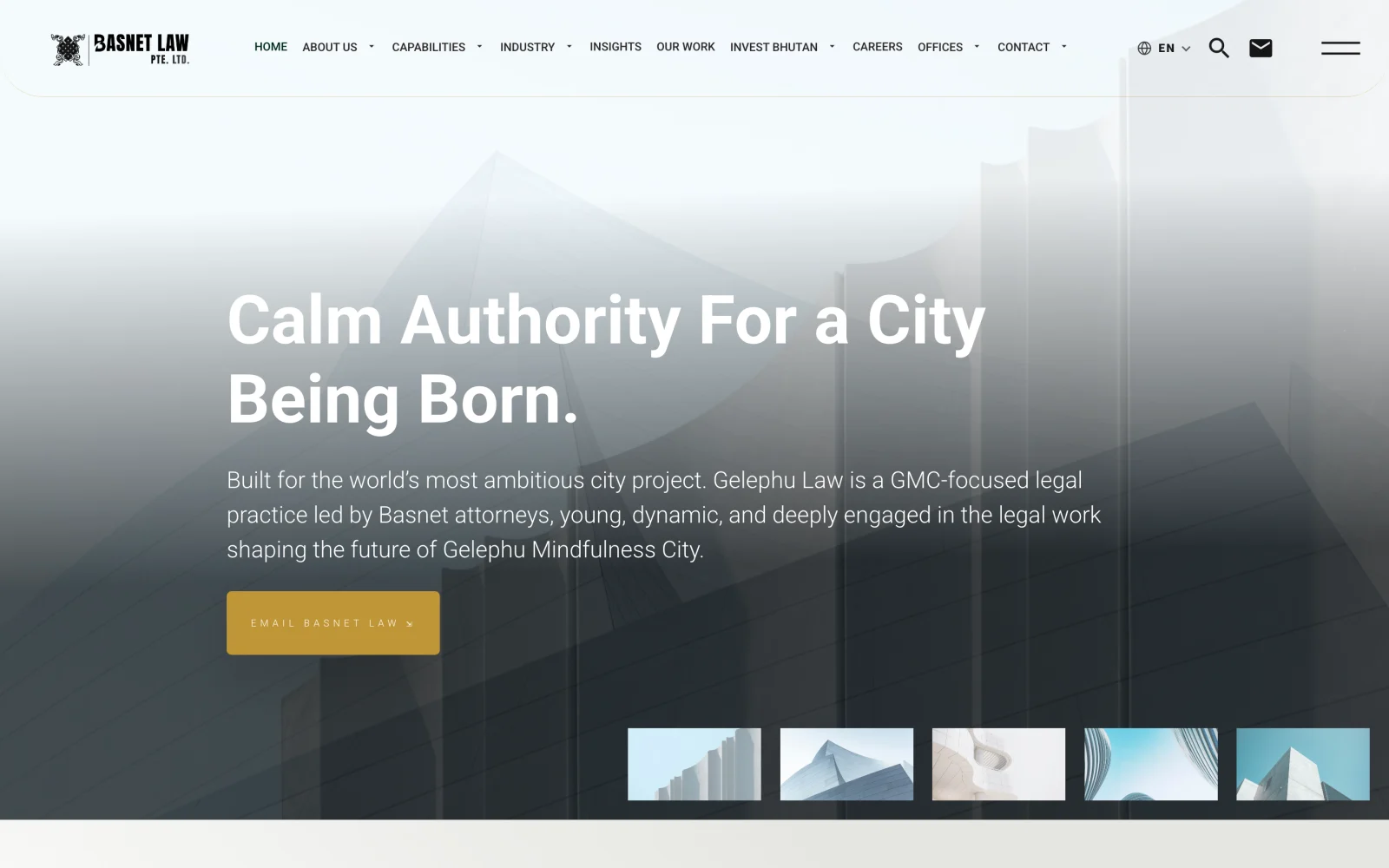
Basnet Attorneys & Law
A full-service firm site for a national market. Every capability has its own page, from foreign direct investment to dispute resolution, and industries have separate pages so a visitor can arrive by sector as well as by legal topic.
- A page for each capability and each industry
- Articles, news and press releases in one library
- A separate section for Gelephu Mindfulness City work
- Published policies, including attorney advertising
Basnet Law Pte. Ltd.
A site for a new jurisdiction, where clients arrive with questions before they arrive with instructions. The site answers them: service pages for each kind of advice, plain-language guides, a glossary and a law library.
- Service pages for each area of advice
- Guides, a checklist, FAQs and a legal glossary
- A page written for international firms seeking local counsel
- Structured data that describes the firm to search engines
How an engagement runs
- 01
Review
We look at your current site, your search visibility and your public record, and tell you plainly what we found. You can use the findings whether or not we go further.
- 02
Plan
We agree what the firm wants more of, which practice areas and which markets, and write a short plan: what will be built, in what order, and who does what.
- 03
Build
We do the work in stages and you approve each one. Lawyers check every statement about the law and the firm before anything is published.
- 04
Measure
We agree in advance what will be counted, such as enquiries and search visibility for named topics, and we report against that, including what did not work.
What we will not do
Legal marketing has a poor reputation in places, and some of it is earned. These are our limits.
No promised positions
Nobody controls a search engine’s results, so we never promise a position in them. We commit to the work and report honestly on the result.
No bought rankings
Rankings on Global Law Lists are free to enter and cannot be bought. Using our marketing services has no effect on any ranking decision.
No invented reviews
We never write, buy or solicit fake reviews, and we do not publish client names or matters without consent.
No claims a regulator would reject
Lawyers work under advertising rules. We write within them, and your firm approves every page before it goes live.
No lock-in
Your domain, your website and your content belong to the firm. If we stop working together, you keep all of it.
The complete guide to law firm marketing
Thirteen parts, written for partners and practice managers. Read it through once; use the linked guides when you reach the part you are working on.
What law firm marketing is
Law firm marketing is everything a firm does so that the right clients know it exists, understand what it does, and trust it enough to get in touch. It includes the website and search, but also the firm’s name in rankings, the articles its lawyers write, the way referrals are thanked, and how quickly the phone is answered.
It is not the same as advertising. Advertising is paid space. Marketing is the wider work of being findable and credible. Many successful firms never buy an advertisement, and no firm succeeds for long without being findable and credible.
Why it matters more than it used to
- Referrals are checked
A recommendation still starts most instructions. What has changed is the step after it: the client searches the firm’s name, reads the site and looks for independent confirmation. A weak or outdated presence loses work the firm had already half won.
- Clients search by problem
People and businesses who have no recommendation search for the problem they have, in the place they have it. Firms with a clear page on that exact subject are found. Firms that list twenty practice areas on one page are not.
- Work crosses borders
General counsel and foreign law firms look for local counsel in jurisdictions where they know nobody. They rely on what can be verified from a distance: a clear website, a complete profile, and recognised rankings.
- AI assistants answer first
A growing share of questions is answered by an AI assistant that summarises the web. Firms whose expertise is published clearly and consistently are the ones those answers draw on. See AI search for law firms.
Start with positioning
Before any website or campaign, a firm should be able to finish three sentences. We act for these clients. We handle these matters. Clients choose us because of this. If the partners cannot agree on the answers, no amount of marketing will make the firm look clear to outsiders.
Positioning is a choice about what to be known for, and it always means leaving something out. A firm that says it does everything for everyone gives a client no reason to choose it. A firm known for one thing in one place is easier to find, easier to refer and easier to remember. You can widen later from a strong base.
Write the answers down in plain words and use them everywhere: the home page, lawyer biographies, your profile on Global Law Lists, ranking submissions. Consistency is what makes a firm recognisable.
The website is the centre
Everything else points to the website. Search results, profiles, rankings, articles and business cards all send people there, so it is the one asset worth getting right first.
A good law firm site has a page for each practice area written for clients, a page for each lawyer with real detail, clear contact routes on every page, and proof: representative matters where the rules allow, publications, recognitions. It loads quickly, works on a phone, and can be used by someone with a screen reader.
A common mistake is to treat the site as a brochure that is finished at launch. The firms that win work from their sites keep adding to them: a new guide when the law changes, a new page when the firm takes on a new kind of work. See law firm website design.
Search: how clients find firms they do not know
Search engine optimisation, or SEO, is the work of making sure the firm appears when someone searches for what it does. It has three parts. The technical part makes the site fast, secure and readable by search engines. The on-page part makes each page clearly about one subject. The authority part is the firm’s reputation on the wider web: who links to it and who mentions it.
For firms that serve a city or region, local search matters most. That means a complete business profile, consistent name, address and phone number everywhere, and genuine client reviews where your bar permits them. See local SEO for lawyers.
Search takes patience. New pages are often found within weeks, but a firm’s standing for competitive topics builds over months. Anyone who promises a quick first position is promising something they do not control. See law firm SEO.
Content that shows expertise
Clients cannot judge legal skill directly, so they judge what they can read. A clear explanation of a new regulation, a practical guide to a process, or an honest answer to a common question shows how the firm thinks.
The most valuable content is usually the least glamorous: thorough practice area pages, guides to procedures clients actually face, and answers to the questions lawyers hear every week. Write for the client, not for other lawyers, and keep each piece up to date.
One strong guide that is maintained is worth more than fifty short posts that are not. See law firm content marketing.
Recognition: profiles, rankings and reviews
Independent confirmation matters because a firm’s own site is, in the end, the firm talking about itself. Clients look for a second source.
Profiles. A complete profile on a legal network gives clients and other firms a place to confirm who you are, where you practise and what you do. On Global Law Lists, 141,000+ law firms are listed across 240+ jurisdictions, and member profiles show their verification.
Rankings. Legal rankings are read by general counsel and by foreign firms choosing local counsel. A good submission is specific: named matters where permitted, clear roles, and referees who will answer. Most weak submissions fail on preparation, not on merit.
Reviews. In consumer practice areas, client reviews influence both clients and local search. Ask for them in a way your bar permits, never offer anything in return, and reply to them professionally. See profile, rankings and recognition.
Referrals and relationships
For most firms, referrals from other lawyers, accountants, bankers and past clients remain the largest source of work. Marketing does not replace them. It supports them.
Make referring easy. Tell your contacts precisely what you handle and what you do not, so they know when to think of you. Acknowledge every referral, report back on the outcome where confidentiality allows, and refer work in return where it is right for the client.
Cross-border referrals follow the same logic at a distance. A foreign firm sending a client into your jurisdiction needs to be confident it will not be embarrassed, and it forms that view from your site, your profile and your record.
Paid advertising: when it fits
Paid search and paid social advertising can bring enquiries quickly, and they suit some practices, mainly high-volume consumer work. They stop the moment the budget stops, and in competitive areas the cost of each click is high.
We do not run advertising campaigns. We mention them because an honest guide should: for some firms they are the right tool, and a specialist agency is the right supplier. Whatever you spend on advertising, the visitor lands on your website, so the website and its pages still decide whether the spend pays.
Measure what matters
Count the things that lead to instructions, not the things that are easy to count. Useful measures are enquiries by source, enquiries that became matters, and the value of those matters. Visits and impressions are worth watching only as early signs.
Ask every new client how they found the firm and record the answer on the matter. It takes ten seconds and, after a year, tells you more than any dashboard.
Review the numbers every quarter, stop what is not working, and put the effort into what is.
Budgeting without guesswork
There is no correct figure for a marketing budget. A firm that wants to hold its position needs less than one entering a new market. Start from the goal, list the work that goal requires, and cost that work.
Separate one-off costs from continuing ones. A website is mostly a one-off. Search and content are continuing work, and they compound: an article written this year still brings readers next year.
Include lawyers’ time. The largest hidden cost of marketing is the partner hours spent reviewing pages and writing articles. Plan for it, because work that waits for review does not get published. See law firm marketing plan.
Professional conduct rules
Lawyers’ marketing is regulated. The rules differ by jurisdiction, but common themes are these: communications must not be false or misleading, claims of specialisation may need to be supported or certified, client confidentiality survives the end of a matter, and testimonials and comparisons are restricted in some places.
Check your own bar or law society’s rules before publishing, and keep a record of who approved each page. A marketing supplier can draft within the rules, but responsibility stays with the firm.
In-house, or with help
A small firm can do a great deal itself: complete its profiles, ask for reviews, write one useful article a month. The marketing ideas guide lists twenty-five things a firm can start without outside help.
Outside help makes sense for work that needs specialist skill or sustained time: building the website, technical search work, and preparing ranking submissions. When you choose a supplier, ask to see live work, ask who will actually do yours, and ask what happens to your site and content if you leave.
Growth also changes the question. A firm adding lawyers and offices needs systems as well as visibility. See how to grow a law firm.
Every page in this section
- Law firm website designA site that explains what you do, loads fast and turns visitors into enquiries.
- Law firm SEOTechnical, on-page and content work so clients find you in search.
- Profile, rankings and recognitionA complete profile, well-prepared ranking submissions and a consistent record across the web.
- Law firm marketing ideasTwenty-five practical ideas, ordered by effort.
- Law firm marketing planHow to write a one-page plan and a budget you can defend.
- How to grow a law firmScaling a practice without losing the quality that built it.
- Local SEO for lawyersHow to appear when someone nearby searches for a lawyer.
- Law firm content marketingPractice pages, articles and guides that show expertise.
- AI search for law firmsHow to be the firm that AI assistants cite and recommend.
Common questions
01What is law firm marketing?
Law firm marketing is the work a firm does so that the right clients can find it, understand what it does and trust it enough to get in touch. It covers the website, search visibility, published expertise, profiles and rankings, reviews, and referral relationships.
02What marketing services does Global Law Lists offer?
Three: law firm website design and build; search optimisation and content; and profile, rankings and recognition. We do not run paid advertising or manage social media accounts.
03Do you guarantee search positions or a ranking?
No. Nobody controls search engine results, and rankings on Global Law Lists are free to enter and cannot be bought. Using our marketing services has no effect on any ranking decision. We commit to the work and report honestly on the result.
04Do we have to be a member of Global Law Lists to use these services?
No. The marketing services are separate from membership of the network, and firms that are not members can use them.
05How are the services charged?
The scope and the administrative fees are agreed in writing before any work starts, so the firm knows what will be done and what it will cost. Send an enquiry and we will reply with the questions we need answered first.
06Can we see examples of your work?
Yes. Two law firm websites we built are live at basnetl.com and basnetgmc.com, and both are shown on this page.
07How long does law firm SEO take to work?
New pages are often found by search engines within weeks. Standing for competitive topics usually builds over months, because it depends on the quality of the content and on the firm’s wider reputation online.
08Who owns the website and the content?
The firm does. The domain, the website and everything written for it belong to the firm, and stay with it if the engagement ends.
09Do you work with firms in any country?
Yes. The network covers 240+ jurisdictions and we work with firms wherever they practise. Each firm stays responsible for checking its own bar or law society’s advertising rules, and approves every page before it is published.
10Does a small firm need marketing?
Yes, though not much of it. A clear website, a complete profile and a habit of asking satisfied clients for a review are enough to put a small firm ahead of most of its local competitors.
Tell us about your firm
Only your name and email are required. We reply to every enquiry, usually within one business day.
- 01
Tell us about the firm and what you would like help with.
- 02
We reply by email with the few questions we need answered first.
- 03
You receive a written scope. Nothing starts until you have agreed it.