
Law firm website design that earns the enquiry
A site built around the questions clients ask, with a proper page for every practice area and every lawyer.
Photo: Leon Seibert / Unsplash
A law firm website has one job: to let a person with a legal problem decide, in a few minutes, that this firm handles their kind of matter and is worth contacting. Design serves that job. We plan the structure first, write or edit the pages with your lawyers, and build a site that is fast, accessible and easy for the firm to keep current.
What the work includes
The scope is agreed in writing before any work starts, so the firm knows exactly what will be done.
- 01
Structure and page plan
We map every page before any design begins: practice areas, industries, lawyers, offices, publications and policies. The plan shows what each page is for and which search it should answer.
- 02
Design in your identity
Layout, typography and colour built from the firm’s existing identity, or a refreshed one if you want it. The design is restrained on purpose: clients come to read, and the page should get out of their way.
- 03
Practice area and industry pages
One page per subject, written for clients. Each explains the problem, how the firm helps, who leads the work and how to get in touch.
- 04
Lawyer profiles
Profiles with real substance: admissions, languages, representative work where the rules allow, publications and a direct way to make contact.
- 05
Speed and accessibility
Pages that load quickly on a phone and on a slow connection, with readable contrast, keyboard access and text alternatives, so that every visitor can use the site.
- 06
Structured data
Machine-readable details about the firm, its offices and its lawyers, so that search engines and AI assistants describe the firm correctly.
- 07
Contact routes and forms
A clear way to make contact from every page, with forms that ask only for what the firm needs and are protected against spam.
- 08
Policies and notices
Privacy, cookies, accessibility and, where your bar requires them, advertising and regulatory notices, in the right place and linked from every page.
Two law firm sites we built
Both sites are live. Open them, read a practice page, and judge the work for yourself. They are shown as examples of our work, not as client endorsements.

Basnet Attorneys & Law
A full-service firm site for a national market. Every capability has its own page, from foreign direct investment to dispute resolution, and industries have separate pages so a visitor can arrive by sector as well as by legal topic.
- A page for each capability and each industry
- Articles, news and press releases in one library
- A separate section for Gelephu Mindfulness City work
- Published policies, including attorney advertising
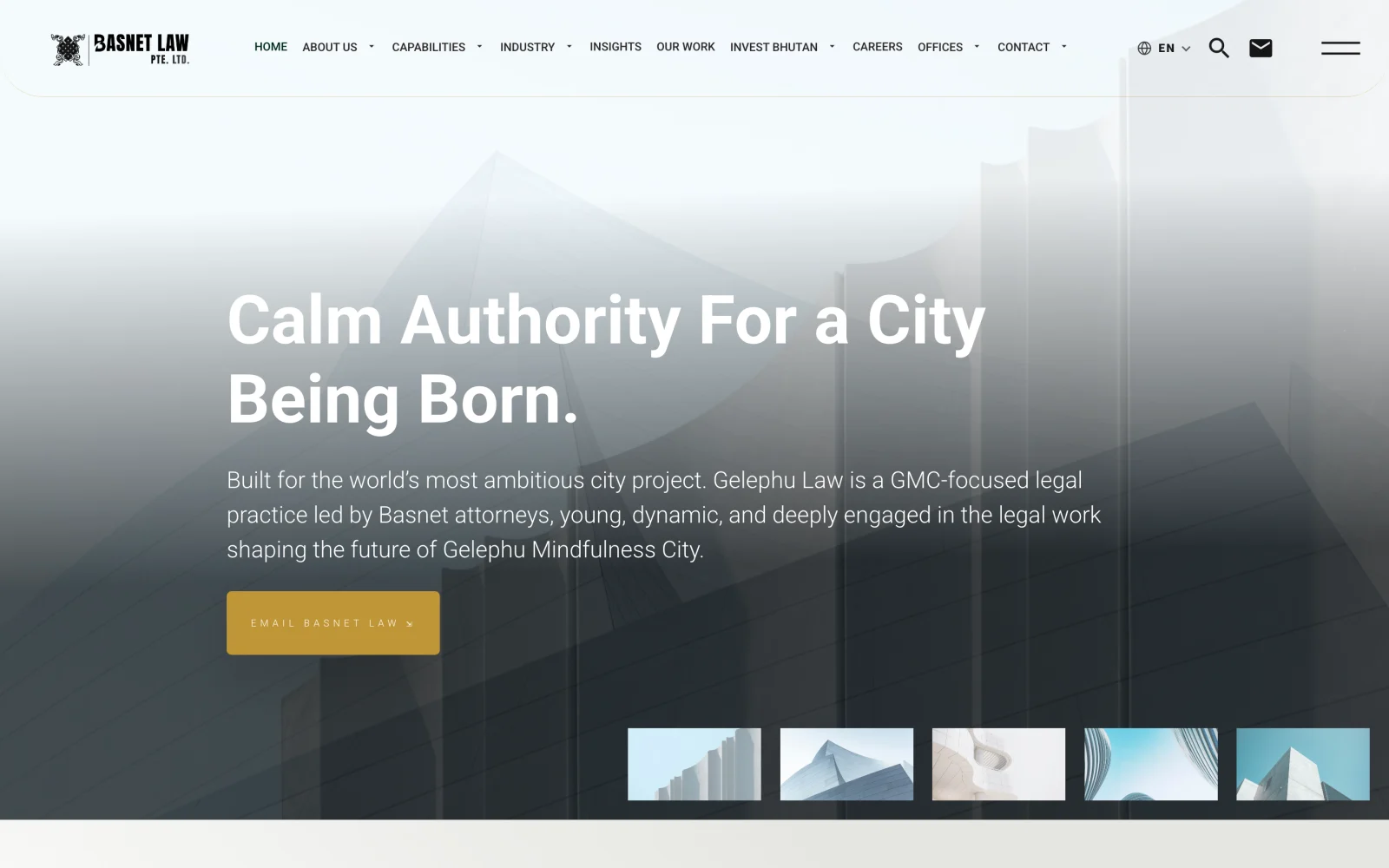
Basnet Law Pte. Ltd.
A site for a new jurisdiction, where clients arrive with questions before they arrive with instructions. The site answers them: service pages for each kind of advice, plain-language guides, a glossary and a law library.
- Service pages for each area of advice
- Guides, a checklist, FAQs and a legal glossary
- A page written for international firms seeking local counsel
- Structured data that describes the firm to search engines
What makes a law firm website work
- It answers the first question quickly
A visitor should know within seconds what the firm does and where. A home page that opens with a slogan and a photograph of a skyline tells them neither.
- Every subject has its own page
A single page listing every practice area cannot be found in search and does not persuade anyone. A dedicated page for each area can do both.
- It shows the people
Clients instruct lawyers, not logos. Profiles with detail, and a photograph taken this decade, do more than any paragraph about the firm’s values.
- It offers proof
Representative matters, publications, rankings and memberships, each stated accurately and within your professional rules.
- It is easy to act on
A phone number that can be tapped, an email address that is visible, a short form. Do not make a prospective client hunt for a way in.
The pages every firm needs
At a minimum: a home page, a page for each practice area, a profile for each lawyer, an about page with the firm’s history and regulatory details, a contact page for each office, and the legal notices.
Firms that want to be found in search add more: pages for the industries they serve, guides to the procedures clients face, answers to frequent questions, and a news section that is actually kept up.
Firms doing cross-border work should add a page written for foreign lawyers and general counsel, explaining how the firm works as local counsel. Both of our sample sites do this in their own way.
Design choices that matter for lawyers
Good legal design is quiet. Generous spacing, one typeface used well, and a small palette make a firm look confident. Stock photographs of gavels and handshakes make it look like every other firm.
Reading comfort matters more than visual effect, because legal pages are long. That means a sensible line length, clear headings, and text large enough to read on a phone without zooming.
Be careful with motion and video on the home page. They slow the site down, and a slow site loses visitors before they have read a word.
Common mistakes
- One page for all practice areas, with a sentence on each.
- Lawyer profiles that list degrees but say nothing about the work.
- No visible phone number or email address on a phone screen.
- News sections whose latest item is several years old.
- Claims such as “leading” or “specialist” with nothing to support them.
- A site the firm cannot update without calling the supplier.
After launch
A website is never finished. Laws change, lawyers join and leave, and the firm takes on new work. The site should be built so that the firm can update a page in minutes.
We hand over the site with a short guide to editing it, and the firm owns the domain, the design and the content. If you want continuing help with new pages and search, that is our SEO and content service.
More on law firm marketing
- Law firm marketingServices, sample work and the complete guide.
- Law firm SEOTechnical, on-page and content work so clients find you in search.
- Law firm content marketingPractice pages, articles and guides that show expertise.
- Law firm marketing ideasTwenty-five practical ideas, ordered by effort.
- Profile, rankings and recognitionA complete profile, well-prepared ranking submissions and a consistent record across the web.
- Law firm marketing planHow to write a one-page plan and a budget you can defend.
Common questions
01How long does a law firm website take to build?
It depends mainly on the number of pages and on how quickly the firm can review them. The review by lawyers is usually the longest stage, so we agree a review schedule at the start.
02Will you write the content?
Yes, if you want us to. We draft from your existing material and from conversations with your lawyers, and the firm approves every page. If you prefer to write it yourselves, we edit for clarity and for search.
03Can you redesign our existing site without losing search traffic?
A redesign can be done safely if the old addresses are mapped to the new ones and redirected, and the pages that already bring visitors are kept and improved. We plan that mapping before the build begins.
04Who owns the site when it is finished?
The firm does: the domain, the design, the code and the content.
05Will the site meet accessibility standards?
We build to the Web Content Accessibility Guidelines at level AA: readable contrast, keyboard access, labelled forms and text alternatives for images.
06Can we see sites you have built?
Yes. basnetl.com and basnetgmc.com are both live, and both are shown on our law firm marketing page.
Tell us about your firm
Send a short enquiry and we will reply with the questions we need answered first. The scope is agreed in writing before any work starts.